Tuesday, 12 August 2014

The Gogarth Experience

     After a drizzly day in the mountains, the sun was shining, so a trip to the sea was in order. To Gogarth. I have not climbed on the sea cliffs since last summer, and I am still growing used to the experience of climbing at Gogarth. Climbing above the sea does not bother me, in fact I quite enjoy the sounds of the coastal environment. It is the rock that I am still growing used to; the weird shapes that have been created, the random quartz which splits through the rock, its texture, and its’ difficulty to read. There are still lots of aspects of these crags that I am becoming more familiar with. The variation in the rock between each different crag in astounding. I have climbed at Castell Helen, Wen Zawn, Main Cliff and Upper Tier, and no two crags are alike. 
3 happy lads above the sea on Lighthouse Arete
     Piers and James both wanted to climb Lighthouse Arete, a route I had done twice before so I gave them the task of guiding me up and they alternated leads. We worked on stance management and rope work as we made progress up the route. Being organised at each belay will prevent any problems with ropes, keeping each of us in the correct position and facing the right way will mean any additional problems will be avoided. We made a quick ascent of the route, with good teaching along the way as there were three of us. 
Climbing in a sea of rock, Imitator Pitch 1
     James and I walked over to the Main Cliff and Upper Tier at North Stack. We scrambled down a loose muddy gully and pushed our way through the heather and bracken towards the rock above the sea. The afternoon sun was baking at the base and the sea calm as we sorted the ropes at the base of our route, Imitator. We had planned to link this two pitch route into Bezel, a three pitch VS on the Upper Tier which would take us to the top of the cliffs. The sun was beating on my neck as I set off up the first pitch, a shallow groove, which was a lot harder than I was expecting, it was only meant to contain 4c moves. The moves that the guidebook described as the crux felt easier than the sustained problem that the groove had proved below. The pitch eased above as I stepped out onto the wall above and followed cracks to the belay. James climbed an easier pitch above and had to have his wits about as the ground turned loose and chossy up to the base of the next route. 
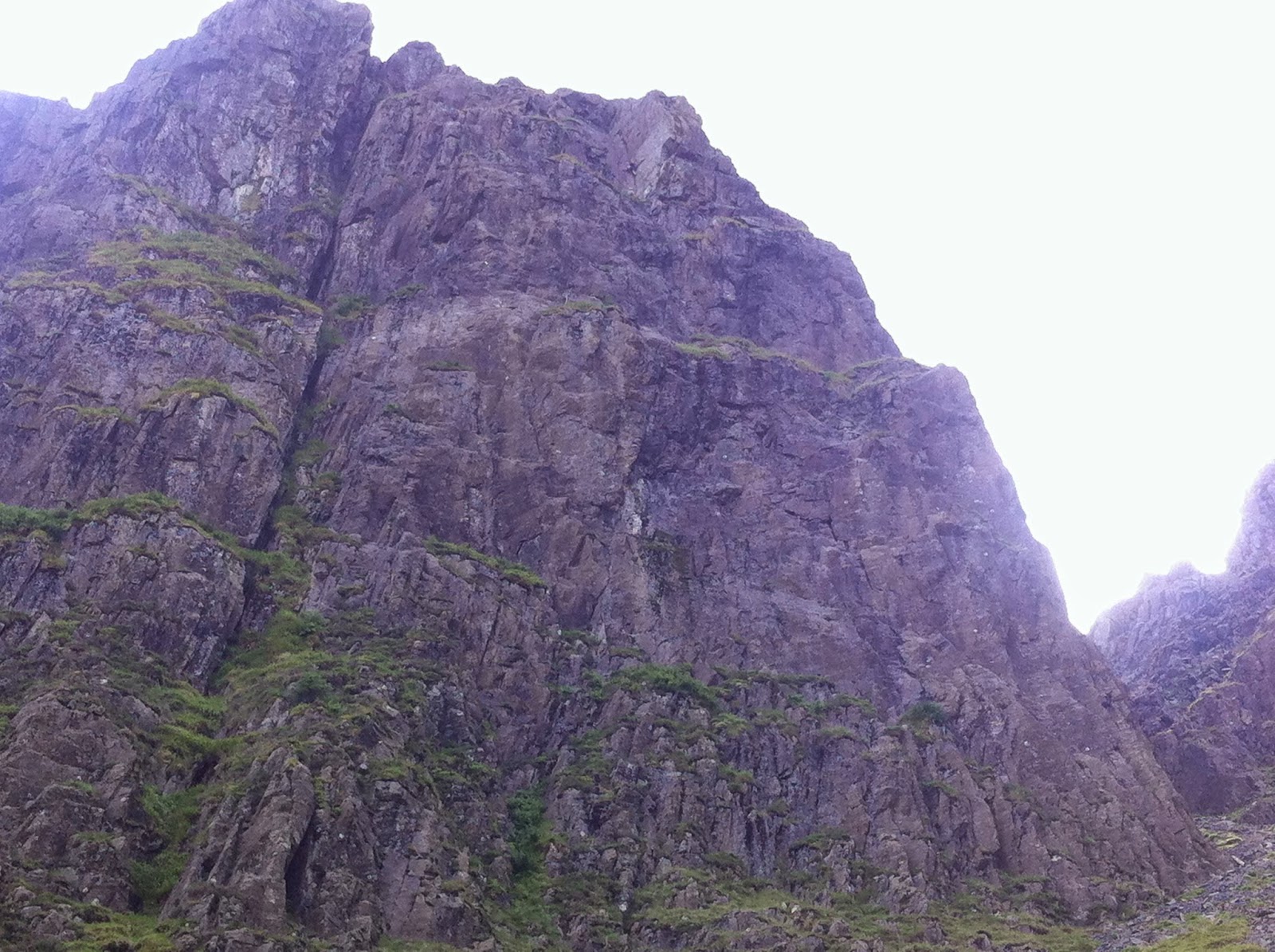
Gogarth Main Cliff. Can you spot us?

     I climbed an interesting pitch into the base of the main groove of Bezel, by climbing a thinner groove before traversing left to reach the belay ledge above. James put his bouldering power to good use, pulling through the crux bulge above, before continuing up the brilliant groove above. The pitch had some great climbing and moves up it, requiring more thought than just brawn. We quickly topped out up the loose slopes above and made haste back to our water bottles and to ice creams. 
Having just reached the first belay of Bezel, Upper Tier.
      I have definitely decided that climbing on the sea cliffs is an area of my climbing that I need to develop. Getting to know the crags better, as well as becoming more comfortable with the rock and the variations between crags. The whole 'Gogarth Experience' is something that I have never come across at another crag; the isolation and self sufficient feeling that you have to continue upwards, the over grown lichen that covers the rock, and to top it off, being above the sea. Gogarth, I'll be back.

Wednesday, 6 August 2014

Alpine Training on Ampitheatre Buttress

     We awoke this morning to very little visibility in the valley which soon turned to drizzle and rain as we drove up through the Ogwen Valley. With improving weather predicted we hoped that this would be true and started climbing up the lane towards Ffynnon Llugwy, our aim to head over the hill to Craig yr Ysfa.  The route, Ampitheatre Buttress an classic alpine ridge almost 300m in length. 
Starting up the lower sections of Ampitheatre Buttress
     I had decided to climb the route in a scrambling style; I took coils and James and Piers tied on the other end. The first sections of the route provided some brilliant cracked slabs, which seemed more difficult than expected. It has been a while since I have done much big boot climbing and it always makes footwork more interesting. Any obvious foot placements would be easy to use in rock shoes; making use of small edges or a smear suddenly become harder to trust once standing in big boots. I pitched the bottom sections more than I anticipated, making numerous belays to bring Piers and James up. 
Looking down the cracking slabs in the lower sections


Piers pulling over the top of the crux corner, the gully dropping down beneath
     After a few pitches that blended together, we relocated ourselves in the guidebook description on a large platform below the crux corner. The corner provided great climbing and a large dose of exposure over the gully below. From here we weaved up small rocky sections covering ground quickly arriving at a knife edge ridge followed by a narrow ridge to the summit. It is a brilliant route, extremely varied with balancy slabs, rock steps and good rock. The forecast was right, as we climbed the sheltered North-East aspect the temperature rose and we were all glad of a strong breeze once we had reached the top. 
James and Piers climbing the lower slabs

The last rock steps up to the top of Ampitheatre Buttress

Tuesday, 5 August 2014

Getting to know Tremadog

     I have headed down to North Wales for the week to become more familiar with some crags and obviously to go climbing. We drove to Tremadog to climb at the popular Craig Bwlch y Moch, however today the crag was not so popular as we were greeted by a thick band of rain as we drove down Gwynant valley. Good job Eric's cafe was open, as we enjoyed a mug of tea and weighed up our options. 


Starting out on The Brothers

     The cloud began to brighten and we were growing impatient so we donned our  waterproofs and walked along the road toward the top end of the crag. I guided James and Piers up Cracked Slab in the wet, taking advantage of its big belays, good gear and endless possibilities for teaching. We followed this up as James led up Boo Boo and the upper slabs were beginning to dry in the wind. I organised a stacked abseil as we retrieved the bags and headed for lunch. 
Me heading up Pitch one of The Brothers
     The wind continued to dry the buttresses and the sun was beginning to break through the clouds. We walked up to Shadrach Buttress. Piers led off up Grim Wall and a rising traverse to a roomy ledge beneath the upper wall. James and I followed and I started racking up for the upper pitch climbing the steep rib above. It was a great pitch and the route deserves its' two stars, never desperate climbing but a little tricky to read because of so many holds at different angles. 
Piers following the top pitch of The Brothers
     We followed this up each picking a pitch of The Brothers to lead. I had already lead Shadrach before so James had the top pitch, Piers the middle and I got to enjoy the wide crack at the base. The Brothers took in three good pitches with a balancy traverse in the middle and the class top pitch of Shadrach which James climbed in good style. We definitely made a good shout with the weather and it cleared up to be a great day craging. 

Sunday, 3 August 2014

Over ont NY Moors

A long day in the Lakes the previous day and a terrible front of rain on its way, James and I headed East, as far as we could to give us as much climbing time as possible. We opted for Wainstones high on the North Yorkshire Moors, hoping that the wind would dry the crag after any showers passed more. Neither of us had been to Wainstones, so its always nice visiting somewhere new, exploring the crag, matching the guidebook to the crag in front of you. There are some good strong lines there, and many easier lines, which provided us with some nice routes to warm up on and familiarise ourselves with the softer Moors sandstone and its nodules of iron ore. 
James on Miss Muffet, Wainstones
I have never really taken to soloing, and even routes of VDiff and Severe get my heart going when I am 10 metres up them. I know that I can do the climbing and have complete belief in my ability to climb these routes. Perhaps I need to put myself into that situation more regularly to become more comfortable with it. 
Me on the Steeple and James on the Needle
We had a good run around the crag, following each other up routes, and the routes that we didn’t want to commit to soloing tying in and making short work of them. Although the routes are short they provide some good moves and are worthwhile. We obviously had to stand on top of the Needle and Steeple as well. It was a short sweet session before the rain came, and it rained hard as we dashed to the car. 

Friday, 1 August 2014

Teaching Climbing the Shepherds Way

Working towards my MIA is leading me on a path to develop all aspects of my climbing and I am finding this to be a very rewarding experience. As well as obviously demonstrating my personal climbing skills and knowledge to assessors I will complete a teaching day on assessment. There is so much more to a day than just taking people climbing than just guiding them and ticking routes. After a pretty relaxed start I picked up Finn and James and made the trip to the Northern Lakes, back to Borrowdale and Shepherds Crag. The forecast was looking suspect and the sheltered quick drying nature of the crag made it a perfect choice for our day. 
Finn and James on the first belay of Ardus 
I had climbed a little with Finn before as he is a student on the BTEC course at The Wensleydale School. He has done a fair bit of climbing before but mainly indoor bouldering and a bit of top roping. This was the first time I had climbed with James, who is a Trainee Instructor at nearby Bewerley Park Centre, who has done a lot of climbing on the grit and limestone crags of Yorkshire. James is hoping to attend his MIA training next year so coming out with me was a real eye opener to me and he learnt a lot of new terminology. 

We started at Brown Slabs, climbing the two pitch Brown Slabs Direct, working with parallel ropes to get the guys climbing and warmed up. The VDiff climbing was no issue for them, I just wanted to get them used to the rope work and the different tasks that need to be sorted on stances. It also gave me a chance to work on my stance management and organising Finn and James once they reached the belay. 
Finn climbing the corner pitch 2 of Ardus
I felt that they needed to challenged in their climbing so we moved around the corner to Brown Crag Wall, a VS- but three good pitches of climbing with good roomy stances. We began working in series with our ropes with Finn as the middle climber. The climbing was definitely a step up from the previous route and suited both Finn and James. Finn was learning how to set up belays, selecting gear placements to create good angles and in correct direction before belaying James up to join us. James was like a sponge, asking loads of questions about stance management. We repeated our order up the next two pitches of the route, consolidating Finn’s learning. He was picking it up extremely well and was happy with little intervention from myself other than checking it all, prior to bringing James up to join us.  
Finn delicately climbing across the final slab of Ardus
It was great for me to go back to these routes that I had climbed a few years ago, just as I was beginning to develop my own multipitch climbing. Working back along the crag we chose Ardus as our next route. Three brilliant pitches of climbing, all with different character, a bold slab, a bridging corner and a delicate exposed slab and crack to finish. At the base of the route, I went into further depth of building belays and each of the principles that need to be followed to create a safe belay and explained the route to Finn and what his tasks were at each belay. It was a brilliant route, with good climbing by Finn and James up the polished corner and final slab. There was a great balance of climbing which pushed them through the pitches and learning at belays. Straight into more ropes as I organised a stacked abseil to get us back down to the bags which went without a hitch. Finn was keen for one more route but with time pushing, I pointed James in the direction of Kransic Crack Direct, a great HVS single pitch which would also push Finn’s climbing on the second, and the lads both climbed it in good style. 
Finn belaying James up the final crack of Ardus
The focus of the day was to develop Finn’s understanding of building belays and rope work, and this was certainly addressed and it was great to have such focussed climbers who really want to develop their climbing. I think that is something I am most looking forward as a Mountain Instructor, teaching climbers the skills that they will require to go to the crags and climb safely themselves. 

Tuesday, 29 July 2014

Lakeland Crags Exploration and Revival

Following on from my two days walking in the Lakeland fells, I was back over in Cumbria climbing within the Northern Lakes. In the middle of a brilliant spell of dry weather, most of the crags and routes within the Lakes will be dry and ready to be climbed. I was keen to take advantage of this and head high into the mountains to these crags escaping the heat in the valleys. Piers and I walked in from Honister across to Gable Crag, ready for the classic Engineers Slabs. Piers’ parents have lived in Keswick for the last 30 years or so and his Dad is still an active climber and recommended that we climbed Sledgate Ridge as an approach route to the Engineers Slab area. 
Engineers Slab with Sledgate Ridge up the left of the picture
I had heard of Sledgate Ridge from the Winter Guidebook but it is a two star Hard Severe in the FRCC Gable and Pillar guide. The first two pitches passed reasonably quickly as we climbed past a fair bit of vegetation and dirty rock, but looking up the third pitch to the belay, it was hard to distinguish the line through the covering of moss that had covered the rock. I set off, picking my way through, trying to match the guidebook description to where I was climbing and it was started to come together. It felt like very adventurous climbing, like we were the first people there, and this pitch wasn’t even given a technical grade! The route actually had some great climbing and is a great companion to Engineers Slabs, it would just benefit from some more climbers enjoying its great moves. 
Piers nearing the crux of Pitch 1 of Engineers Slabs
Engineers Slabs, was as expected a cracking route providing excellent climbing, with a healthy dose of exposure down the steep slopes below. It was no surprise that this route provided great climbing to back up it’s reputation as a classic. There was another team climbing on the slabs next to us, on a route called The Troll. Their route looked brilliant and looking in the guidebook was a two pitch HVS 5b, with the crux pulling round a big bulge after delicate slab climbing below. But to us at the base of Engineers, the route looked like they were climbing a through a sea of moss, delicately pulling and standing on the dried out plants careful not to pull them off the wall. Watching the leader pulling through the bulge looked brilliant moves and I will certainly be back to climb that route. 
The second pulling through the crux of The Troll
The next day we drove over to Buttermere, and I must admit that I had never climbed in this valley and it had been a few years since I had been walking over there. We walked in the scorching heat, the shade getting closer with every step. Eagle Crag stands tall at the back of the large Birkness Combe. I looked large from the valley and grew and grew the closer we got, a huge buttress of rock above us. Our aim today was the another classic, Eagle Front, 150m of brilliant VS climbing. The topo of this crag is covered in routes, which criss cross and intersect as the weave up this huge piece of rock. Rightly so, it is an absolutely top crag, the rock is really rough and featured with grooves, slabs and ledges. As we climbed our route which is three star in its own right, I couldn’t quite believe how many other routes there are, it was impossible to spot any. The crag was very overgrown with a deep layer of moss and vegetation in cracks. Perhaps a soft wire brush would be a useful addition when climbing at these high mountain crags.
The grand buttress of Eagle Crag, Buttermere
Me climbing the brilliant corner on Pitch 7 of Eagle Front
We only had a short climb the following day as we needed to head back across to Yorkshire in the afternoon. Opting for a couple of routes on the shady Northern aspect of Black Crag. Initially it wasn’t quite as hot as the previous two days as we set off out of the trees up The Shroud, a two star VS which provided some great situations. A nice layback crack on pitch one was followed by a steep wall and reachy crux leads to a juggy finish. The other 4c pitch is a complete opposite with an exposed traverse across a slab and a series of grooves. This route was reasonably dirty as well as bits of moss covered hand holds which surprised me considering its two stars which it definitely deserves as well as its close proximity to the road. We followed up this route choosing to climb The Coffin, again a two star VS. Once again, the route provided brilliant climbing, but was absolutely plastered in crusty lichen and moss. This not only will encourage further growth but will mean the route will take longer to dry following rain. Piers lead a class 33m second pitch climbing a series of grooves and walls to high on the crag, however I did have a take cover and pick my moments to look up to avoid the rain of moss and lichen showering down above me. Once again with a bit more traffic this route will be even more deserving of its two star status. 
Piers pulling through the crux of Pitch 2 on The Shroud
The last three days of climbing had got me thinking; is there a decline in Lakeland traditional climbing? I think there is. Are more people choosing a specific styles of climbing, I know there is a very strong bouldering scene within the Lakes and there must be a growth in the numbers of sport climbers moving outdoors from walls to the limestone crags of Southern Lakes and Yorkshire. The selective guidebook to the Lakes covers over 500 climbs at over 60 crags, a lifetimes worth of climbing. There are so many high crags in the Lakes, are there simply not enough climbers to keep the crags clean? I think the sport continues to grow and I hope in a traditional sense as well. In Wales, there are a limited number of high mountain crags, correct me if I’m wrong but I believe that there are more high mountain crags in the Lakes. Are climbers becoming less adventurous themselves, sticking to the convenient valley crags with short walk ins and making the polished routes even smoother. I wouldn’t even consider climbing at Shepherds Crag in the current spell of weather we have had. Whilst at Black Crag that morning, there were six other teams at the crag, every single team climbing Troutdale Pinnacle, one after another, we were the only other team to climb a different route. 
https://www.thebmc.co.uk/arcteryx-lakeland-revival
Just after returning from the Lakes, the British Mountaineering Council have launched a campaign with Arc’teryx called Lakeland Revival. They have compiled a list of 50 routes which they consider to need reviving from plant life and dirt. By climbing a route from this list and taking a picture of you doing it, you will be rewarded with Arc’teryx t-shirt or chalk bag. A nice little incentive just for going climbing. It is great to hear the industry backing our British climbing heritiage. You can read more here: https://www.thebmc.co.uk/arcteryx-lakeland-revival


Catch you on the crags!

Friday, 11 July 2014

Lake District with Wenselydale School

After a busy week in Wales, it was straight back home, clothes through the wash and straight back out on the Monday morning. The high pressure was sticking around, luckily as we had a busy few days planned with Year 12 students from The Wensleydale School in Leyburn. We were staying in the K Fellfarers hut in Seathwaite, a cracking mountaineering club hut with great facilites and an even better library. I could have spent the whole three day trip trawling through the ageing climbing guides and books in the hut. 
Classics - that is all.
What I would give for these on my bookshelf
We headed to Castle Rock of Triermain, Thirlmere. We climbed on the right side of the South Crag, with the students enjoying their first taste of Lake District rock. Initially they found it hard to read, but liked the roughness and it seemed a welcome change to the grit and limestone of the Yorkshire Dales. A few of the students were keen to sample some multi pitch as Jon took a few of them on their first multi pitch routes climbing Yew Tree Climb. 
Busy climbings on the South side of Castle Rock
Jon leading up Pitch 1 of Yew Tree Climb
The second day started with drizzle and low cloud but the sun soon showed it was in charge and it was another blazing afternoon. We headed deep into the mountains, straight from the hut climbing up to Styhead Head tarn and following the corridor route onto Scafell Pike. The students lead us staff on a brilliant mountain walk, keeping the group together and navigating well through the boulders of Broad Crag. 
Jon and Gemma heading round the top of Piers Gill
Heading back down to Borrowdale
Finally we headed to Shepherds, using the tree lined base of the crags to provide us with some welcome shade. We climbed the majority of the routes across Brown Slabs with some students climbing Brown Crags Crack as their first VS. I’m expecting great things from the students as they continue into Year 13 and the second year of their course.